Advertisement
Read how advertisements build a preference through audience appeals, language and design. Explore a separate FIJI Water worked example.
FIJI Water — No Added Chemicals
This walkthrough develops one supported reading. A different interpretation can work if it explains the text’s details and addresses evidence that complicates it.
PRACTICE GUIDING QUESTIONHow do visual contrast and language present FIJI Water as a desirable choice?
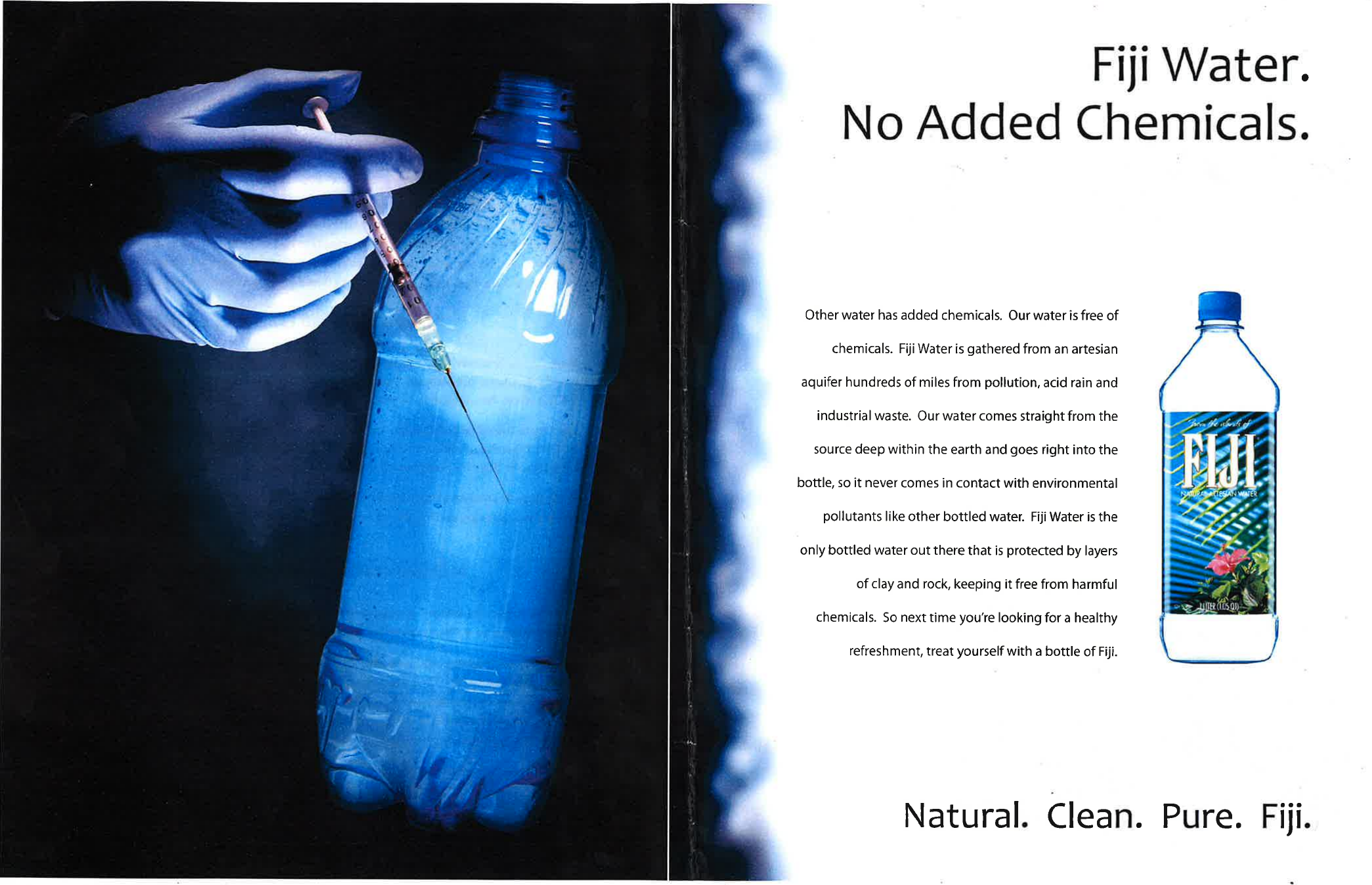
Showing: Whole ad. Switch views to compare without leaving this section.
Practice guiding question
How do visual contrast and language present FIJI Water as a desirable choice?
Read the ad’s wording
The advertiser’s wording, transcribed from this scan. Tiny packaging text is not fully legible.
Headline
Fiji Water. No Added Chemicals.
Body copy
Other water has added chemicals. Our water is free of chemicals. Fiji Water is gathered from an artesian aquifer hundreds of miles from pollution, acid rain and industrial waste. Our water comes straight from the source deep within the earth and goes right into the bottle, so it never comes in contact with environmental pollutants like other bottled water. Fiji Water is the only bottled water out there that is protected by layers of clay and rock, keeping it free from harmful chemicals. So next time you’re looking for a healthy refreshment, treat yourself with a bottle of Fiji.
Closing slogan
Natural. Clean. Pure. Fiji.
Prominent bottle-label wording
FIJI · NATURAL ARTESIAN WATER
Start with the whole advertisement
This FIJI Water advertisement builds a contrast between an unnamed alternative and its own branded bottle. The supplied source is a wide print-ad scan. Begin with the whole composition, then follow Orient → Analyze → Write. Each section pairs the commentary with a useful source view. You can switch to the whole ad or another detail at any point, or enlarge the source for a closer look.
Before reading the model, explain what each side of the spread asks you to associate with bottled water. A reading to test is: the advertisement creates anxiety about artificial intervention, then presents the named product as a reassuring, natural alternative.
The commentary and practice question are original teaching material. The publication date, original placement and photographer are not identified in the supplied scan. Analyze the claims as advertising claims; the image does not establish how competing water is produced.
Audience and purpose
The advertisement addresses potential bottled-water buyers who value a product presented as clean, natural and healthy. The closing reference to refreshment supports that inference. The explanatory copy assumes that distance from pollution and protection underground will matter to the reader’s judgment of quality.
Avoid inventing an exact age, income or nationality for the audience. There is no price, retailer or publication context in the supplied ad to establish those details. Instead, connect the audience’s plausible concern about what they consume with the ad’s contrast between interference and protection.
The purpose is to make FIJI Water seem preferable to competing bottled water and encourage readers to choose it. This is not a neutral explanation of water production: the copy develops a comparison and ends with a purchasing invitation. Its argument combines an unsettling image, a reassuring product claim and an account of natural protection.
The image creates the problem
Zoom into the syringe and unbranded bottle.
The left side gives a large area to a gloved hand holding a syringe beside an open, unbranded bottle. The needle points into the bottle’s silhouette. The harsh lighting and dark background make the action seem suspicious, rather than an ordinary scene of drinking or refreshment.
The glove and syringe carry clinical or laboratory associations. In another context, they could suggest care or precision. Here, the contrast with the headline and the clean presentation of the branded product directs those associations toward unwanted interference. That is anchorage: words help determine how the visual detail is read.
Pathos — fear and unease: the syringe can make an ordinary purchase feel potentially risky. The appeal addresses concern about what enters the body; the branded side then offers reassurance. Explain that emotional movement rather than claiming every reader will be frightened.
The large bottle makes the unnamed alternative conspicuous, but prominence does not make it desirable. The advertisement uses salience to establish a problem before offering a product. The unbranded bottle also allows a broad comparison: it can stand for other bottled water without identifying a specific competitor.
Do not write that the photograph proves competitors inject harmful substances into their bottles. It makes that suspicion vivid. A stronger analytical claim explains how the ad suggests that idea and why it might matter to a concerned buyer.
The headline supplies the distinction
“Fiji Water. No Added Chemicals.” names the product and immediately supplies its distinguishing claim. The short, separate statements make the claim sound definite. The negative “No” defines the brand through the absence of something the adjacent syringe encourages readers to fear.
Read the headline across the spread. The left image supplies a disturbing version of addition; the right wording offers the named product as its opposite. Without the words, the syringe’s purpose would be more ambiguous. Without the image, the claim would lose much of its visual threat. The persuasion depends on that relationship.
The contrast between the dark photograph and the open white space on the right makes the branded side appear comparatively clear and controlled. This is an effect of the arrangement here, not a rule that white always means purity. Blue appears on both bottles, so the argument is more precise when it examines lighting, framing, labeling and surrounding space together.
The copy gives reassurance a rationale
The opening distinguishes “Other water” from “Our water.” The repeated contrast establishes two camps before the copy explains the brand’s claimed advantage. Its account of an artesian aquifer, distance from pollution and layers of clay and rock gives natural protection a concrete setting.
Words describing the source as deep underground and the route into the bottle as direct make the journey seem protected and uninterrupted. The list of pollution, acid rain and industrial waste builds a picture of environmental danger; the account of clay and rock supplies a barrier against it. The explanation turns the headline’s reassurance into an apparently reasoned product story.
Logos — a proposed reason to prefer the product: the copy links a protected source and direct bottling with the conclusion that FIJI is a better choice. Evaluate that chain of reasoning and the evidence it provides, not just the presence of explanation.
The technical term “artesian aquifer” creates a specialized register—a style of language associated with expert knowledge. This contributes to ethos, an appeal to credibility: the brand builds an informed, knowledgeable voice rather than relying only on an established reputation. There is no named independent expert or study in the displayed ad. Technical language can make the account sound authoritative, but does not itself verify the comparison. Likewise, the exclusivity claim that FIJI is the only bottled water with the stated protection asserts an advantage without supplying comparative evidence within this ad.
Notice a shift in scope: the headline refers to added chemicals, while the opening copy makes the broader claim “free of chemicals.” Water itself is a chemical substance. In this context, the ad encourages readers to associate the word with undesirable contaminants. Distinguishing the connotation from the literal meaning helps evaluate the rhetoric without adopting its wording as scientific fact.
The product and slogan resolve the contrast
Zoom into the FIJI bottle, then inspect the closing slogan.
The smaller branded bottle is isolated against the light background. Its recognizable name and leafy, floral label give readers a specific product to choose, in contrast with the anonymous bottle on the left. The plant imagery reinforces the natural associations developed in the copy; it is not evidence of the water’s composition or environmental impact.
The slogan “Natural. Clean. Pure. Fiji.” uses short fragments and repeated full stops to present three desirable qualities as a sequence. Ending that sequence with the brand name encourages the reader to carry those qualities into the final word. The slogan presents FIJI as the preferred choice in the comparison.
The body copy also invites the reader to “treat yourself.” That phrasing makes the choice sound like a small act of care or pleasure. There is no price, deadline or immediate ordering instruction in the displayed ad. The invitation is to favor the brand on a later buying occasion, rather than respond to a limited-time offer.
How the appeals work together
The fear appeal gives readers a reason to worry; the account of natural protection offers a reason to trust the alternative; the informed voice makes that account sound credible. The light setting, plant imagery and positive slogan supply reassurance. Pathos, logos and ethos help explain the same persuasive movement. They do not supply a three-part thesis or essay plan. Keep the argument centered on how the ad turns concern about an alternative into preference for the brand.
Put the spread back together
Switch the source to Whole ad. One plausible movement is unease → distinction → explanation → desirable choice. Another reader might start with the headline. The interpretation does not depend on everyone following a fixed route: the two sides remain in a relationship of contrast, and the headline, copy, product and slogan reinforce it.
Build an analytical response
A possible thesis
The advertisement contrasts a syringe beside an unbranded bottle with the FIJI bottle to make other water seem vulnerable to interference. Its headline and explanatory copy present FIJI as a protected, natural alternative, giving health-conscious buyers a reason to choose it.
This answers the practice question with a persuasive relationship. It does not merely announce that the ad uses images, color and language.
A plan organized around meaning
- Create doubt about the alternative: connect the syringe, the unbranded bottle, the dramatic lighting and the opening comparison.
- Make the brand’s difference seem credible: connect the headline’s negative claim with the account of source, distance and natural protection.
- Turn reassurance into preference: connect the isolated product, the plant imagery, the slogan’s sequence and the invitation to treat oneself.
These are possible lines of argument, not three compulsory paragraphs. Bring language and visual choices together within each idea.
Worked analytical paragraph
The advertisement makes FIJI Water seem reassuring by first presenting an unsettling alternative. The gloved hand and syringe beside the unbranded bottle suggest something clinical and intrusive. “No Added Chemicals” guides the reader’s interpretation of this image: the syringe appears to add something unwanted, while FIJI is presented as free from it. The light space around the FIJI bottle also contrasts with the dark photograph on the left. Together, these choices associate the branded product with protection and the alternative with interference. This may appeal to buyers concerned about what they consume. However, the staged image suggests a difference between products; it does not prove that competing waters are unsafe.
What the reasoning does
- Proposes a meaning: reassurance depends on an unsettling alternative.
- Locates specific visual details and quotes the relevant wording.
- Explains how the headline directs the reading of the image.
- Connects the contrast with an audience concern supported by the text.
- Evaluates the strategy while distinguishing suggestion from proof.
Use the Paper 1 guide for the wider reading and writing method. Becky’s CDC example there demonstrates a different persuasive situation: a public-health call to change behavior. It remains a separate assessment example.
Avoid and revise
Thin: “Blue makes the audience feel calm and want to buy the water.”
Developed: “Because blue appears in both bottles, the more significant distinction is between the dark, intrusive syringe image and the clearly labeled product isolated against white.”
Thin: “The image proves that other companies add dangerous chemicals.”
Developed: “The syringe dramatises artificial intervention, while the headline encourages readers to treat FIJI as an exception; the ad supplies an association rather than proof of competitors’ practices.”
Thin: “The target audience is rich adults aged 30–50.”
Developed: “The emphasis on protection from pollution and the closing reference to healthy refreshment address bottled-water buyers concerned about quality.”
Avoid treating the model as either a scientific product review or a list of tricks. Explain how the particular wording and design build a preference, then evaluate the support and limits of that argument.
Practice and transfer
Choose the body copy or the closing slogan. Write a short paragraph explaining how its language develops the visual contrast. Include one precise phrase, one visual detail and a connection to audience or purpose. The writing space below gives you a place to try this before returning to the model.
For another advertisement, begin again with its actual offer and evidence. A luxury brand might sell distinction without explaining production; a charity appeal might connect an individual story with a donation request. Reuse the questions about audience, image–text relationships and desired response. Do not assume every ad uses FIJI’s opposition between interference and nature.
Try a connected reading
Work with the body copy or closing slogan. Connect what it says with how the product is presented.
This exercise does not send writing to AI.
Review your paragraph
- Have I supported my audience inference with details from the ad?
- Have I connected a verbal choice with a visual choice?
- Does the paragraph develop one interpretation rather than list techniques?
- Have I distinguished a product claim or suggestion from established fact?
- Have I returned to the whole spread to check the relationship?